Showing posts with label Then and Now. Show all posts

Thursday, August 6, 2015

Back to School Then and Now


Longfellow Elementary School  Salida School District R-32

It is that time of the year where  children in America prepare to go back to school. Going to school has changed in many ways in the last one hundred years. In the early 1900's many children were educated at home or attend school in one room schoolhouses. An example of a one room schoolhouse is still found in Maysville, Colorado. It was built in 1882 when the town of Maysville was a booming mining community at the base of Monach Pass.  While the town of Maysville  is now a ghost town,  the near by community of Salida grew. Today approximately 1100 students attend one of six schools in the same mountain area. One of those schools is Longfellow Elementary where over four hundred students in grades Kindergarten thru 4th grade attend each year. It is ranked as one of the best elementary schools in Colorado.
 One hundred years ago only one teacher was in charge of a schoolhouse.

The teacher, often known as the Schoolmarm was usually an unmarried woman. She was responsible for preparing and teaching individual lessons in a variety of subjects for several children of different ages and education levels. The children all sat together in the same classroom sharing a bench or desk.
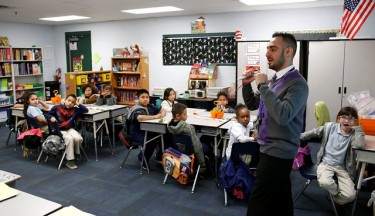
Today school buildings have many classrooms where both men and women are teachers.In the elementary grades they teach basic subjects to only one grade level of students at a time. Teachers in middle and high schools teach one subject per class that may have a mixed grade levels of students. The children in schools today sit at their own desk or  table space. 


Old School
Desks in a One Room Schoolhouse
These small desks were made of wood as the children sat close together in the small room.


Modern desks and classroom Salida High School 2013 Desks in schools today are made of plastic, metal and wood. They are easier to move around in the larger classroom that is often has carpet on the floor to reduce noise.


Old School Books and Slate


 by SusanSavad

Create one-of-a-kind 

picture post cards at Zazzle


School Supplies in the 1900's


 The school supplies list for students one hundred years ago was very short. The cost for these items also seems very inexpensive compared to the cost of school supplies today.


Pencils (dozen) .15 
Tablet (100 sheets) .05 
Crayons (1 dozen ) .15 
Book Straps ( 1 pair) .05 
School Bag .05

School Supplies in 2015


Today students have a never ending list of supplies needed for school. They also need backpack, bags and containers to keep items organized. Depending on the grade level and subjects students  many also be required to purchase various technical items as additional school supplies. These include calculators, scientific instruments,  ipads and lap top computers.  
School Supplies & Tools Collage


Public and Private schools create  extensive lists of required school supplies each year.  These lists do not include the backpacks, lunch boxes and containers that the student may also need. School Supply lists for older students in the Middle and High School grades vary based on each subject they are enrolled in.

   School Clothes 

 One hundred years ago school clothes for children were  hand sewn by their mothers, or ready made outfit could be purchased for about $5.00.  The girls had school dresses and the boys had suits, they both wore long black stockings. Mothers could purchase wool flannel, gingham check and calico fabrics costing .05 cents to .12 cents per yard.  Children shoes ranged in price from .43 cents to $3.15 a pair and stocking cost .25 cents.  A boys waist shirt and trousers could be purchased for a combined cost of $1.50.


 Today  the style  and cost of school clothes vary depending on the age of the student and if the school they attend has a dress code or require uniforms.


One hundred years ago the cost of clothing and school supplies for each child was $20.00 or less. 

This year the estimated cost for each child going to school in America for the 2015 school year has been estimated as follows by Huntington Banks. 
$649 for Elementary School children
$941 for Middle School children
$1,402 for High School student


The Comrade., September 09, 1910, Image 5


Bisbee daily review., September 03, 1905, Page PAGE EIGHT, Image 8

Wednesday, July 29, 2015

Literacy in America Then and Now


Literacy in the 19th century was defined as the ability to read and write. Early American Leaders believed this was an important quality to guarantee a healthy democracy. Thomas Jefferson wrote his concerns about literacy in 1816 stating “Where the press is free, and every man able to read, all is safe.”

America's obsession with literacy was  evident in the colonies long before they became the United States. In 1642, Massachusetts passed a law to monitor children’s ability to read and understand the principles of religion and the laws of the country. Every Man Able to Read

In the past 239 years since the USA became a country there have been hundreds of laws created at the federal and state levels to address education and literacy. In 1980 the current Department of Education was created, their mission is: To promote student achievement and preparation for global competitiveness by fostering educational excellence and ensuring equal access.  Each year  millions of dollars generated from taxes are spent on public education at the state and federal levels.U.S. Department of Education 


Fast forward to 2015 where the definition of literacy has changed in America today. The new term Functional Literacy is defined as the ability to apply reading, writing, math and technical skills in order to be productive in society.
 The ability to read and comprehend at a 8th grade level and do general math functions at a 6th grade level are the standards often used to determine Functional Literacy. Functional Illiteracy in the United States  Literacy and education continues to be a value that is addressed by many leaders in America today, however it does not often have the important priority that the first leaders of the United States gave it. Functional Illiteracy and Literacy Problems in America 

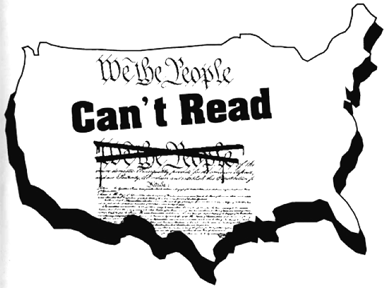
Unfortunately not every adult in American can read, consequently all is not safe in our country. The illiteracy rate of adults in the United States has increased during the past thirty years.

It is estimated that currently there are 32 million adults living in America that are considered to be illiterate.
This means 14% of the adult population in the United States cannot read. 
An additional 23%  or  44 million American adults are not able to read above a basic proficiency level.
For American adults who can read, there are 63 million who can only read between a 6th and 8th grade comprehension.23 Statistics on Adult Illiteracy 


  The illiteracy statistics indicate then that 36% or 1/3rd of the American adult population cannot read at a  functional literacy level. If they cannot read at a functional level then they also struggle with writing, math and computer skills. These adults struggle personally everyday to survive financially and socially in our modern society. They have difficulty performing tasks that involve reading and computers. Where they struggle to read and complete health information, prescriptions, driving tests, election ballots, job applications and official documents. Their inability to function efficiently affects the entire country.
  The high percentage of adult illiteracy in our country has several on going negative effects on America's well being. Financially illiteracy is very expensive, the majority of prisoners in state and federal prisons are classified as low literactes. Many illiterate adults are unemployed or underemployed and depend on government programs to support them and their families. Proliteracy.org 

With the average readability level of American adults at 7th grade comprehension. News articles, blog posts, websites and documents are frequently revised to accommodate lower reading levels. The U.S. Illiteracy Rate Hasn't Changed In 10 Years 
  When a large portion of the American adult population struggles with reading it creates many changes in our society. Author Chris Hedges address how illiteracy affects our society in his book  from 2009 titled: Empire of Illusion: The End of Literacy and the Triumph of Spectacle. He believe that when a large portion of the population is illiterate another society is  created where people live in a false world. In this video from 2012 Mr. Hedges explains how we now live in two societies; the first is literate and can cope with complexity. The second is retreating from a reality-based world into one of false certainty and magic.


So Thomas Jefferson and the founding leaders of America did have insight as to the importance of literacy as a value  to keep the country healthy and safe.